Founder Resources
A focused first market and a larger ambition can coexist. Build an expansion hypothesis grounded in customer evidence, local expertise and trusted relationships.
TGN Ventures
·

Build evidence in one well-defined market while explaining why the business could work elsewhere. Those are different jobs: the first tests whether customers value what you do; the second tests which parts of the business can travel. Expanding before you understand the first can spread uncertainty across more markets.
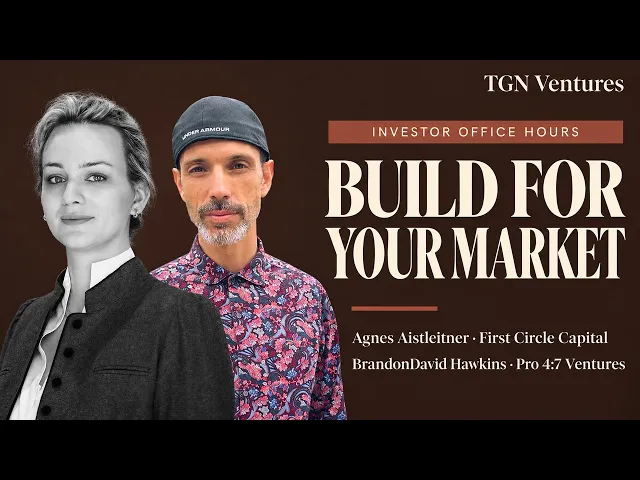
That distinction connects two perspectives from TGN Investor Office Hours on November 6, 2026. Agnes Aistleitner, Co-Founder and Managing Partner at First Circle Capital, discussed her firm’s early-stage African fintech focus and what makes a business credible beyond its first market. BrandonDavid Hawkins, Founder and General Partner at Pro 4:7 Ventures, drew on his work connecting founders, investors and the creative economy to explain the value of earning trust locally before extending it through relationships.
Their advice came from different investment perspectives. It does not create a universal expansion formula. It does suggest a useful question for a founder: what must we prove here before we ask another market to trust us?
Separate the first market from the larger opportunity
Agnes asked founders to consider whether a proposition serves only one market or could be exported. In her venture-investment context, a narrowly defined, low-margin opportunity in one country may not support the scale the investor seeks. Her question was about the business’s potential and the team’s ability to reach it.
That is different from telling every founder to enter several countries immediately. When a South African founder asked BrandonDavid about growing beyond the home market, he returned to the strength of the initial base. He compared it with artists building an audience in their own territory before reaching other audiences through partners and relationships.
Our editorial application is to write two separate statements. First: the specific customer and problem we are serving now. Second: the reason the solution might be useful elsewhere. Keep the second statement as a hypothesis until you have evidence. A large map is an ambition; it is not a distribution plan.
Prove customer value before calling early interest product-market fit
Agnes cautioned against deciding too quickly that a business has product-market fit and then putting more money into marketing. She wanted to understand what founders had done to test their assumptions with customers, how resourceful they had been, and why customers would continue to value the product.
She also declined to offer one universal traction threshold. The relevant evidence depends on the proposition and business model. That matters when founders compare themselves with companies in different sectors or at different stages.
For your own business, distinguish what you know from what you hope is true. A conversation can demonstrate interest. A pilot can test a workflow. A payment can show willingness to pay. None, by itself, establishes every part of a durable business. Ask what each piece of evidence actually supports, then identify the next uncertainty.
Hypothetical example: a software team receives enthusiastic responses from several local firms. Before entering another country, it could test whether those firms use the product for the problem described, who owns the purchasing decision, and what prevents continued use. Those questions are an editorial exercise, not a reported outcome from the session.
Identify the people and permissions the next market needs
Agnes’s team questions were particularly concrete in fintech. She emphasized relevant technical and financial-services experience, understanding the regulatory path, and the ability to bring strong people around the business. A founder’s idea and confidence do not replace the expertise needed to execute it.
Do the same analysis before expansion. Which capabilities already exist in the team? Which depend on a partner? Which require local expertise? In a regulated business, permission to operate and the responsibilities of each participant need qualified, market-specific review. A model working in one jurisdiction does not establish that it can operate unchanged in another.
BrandonDavid’s relationship emphasis adds another question: who has earned trust with the customers you hope to serve? An introduction may begin a conversation. It does not establish a partnership, access to customers, or a commitment to fund the company. Clarify what each person can actually contribute.
Build relationships around a useful, specific request
For a founder trying to find initial users, BrandonDavid suggested taking an inventory of existing relationships: people who understand the founder, care about the problem, or could offer useful feedback. His advice was to ask people to test and respond, rather than treating every interaction as a request for money.
Apply that idea to market research. Instead of asking someone to open an entire country for your business, ask whether they can challenge one assumption: how customers currently solve the problem, how a buying decision happens, or which local conditions could make your approach unsuitable.
Keep the request honest and bounded. A friendly contact’s encouragement should not be recorded as customer validation. A possible introduction should not appear in your plan as a signed distribution agreement.
Write a one-page expansion hypothesis
The following worksheet is TGN Ventures’ editorial synthesis of the discussion. It is a planning tool, not either guest’s investment checklist.
Current customer: name the customer segment, buyer and problem in the market you already serve.
Evidence: record what customers have actually done, what remains untested, and the limits of the data.
What travels: identify the product capability or customer need you believe exists in the next market.
What changes: list differences in buying behavior, distribution, economics, expertise and permissions that need investigation.
Local learning: identify a credible person or organization that could challenge the hypothesis, and a specific question to ask.
Next decision: define the evidence that would justify another step, as well as what would make you pause.
Make the next step small enough to teach you something useful. It might be a customer interview, a discussion with a qualified local adviser, or a narrowly scoped test. The appropriate choice depends on the business and the obligations involved.
Agnes also encouraged founders to consider two levers in parallel when cash is tight: raising capital and improving revenue or margins with customers. Expansion planning belongs alongside that operating reality. A promising new market should be tested against the time, people and resources it would require from the business you are already building.
You can hold a larger ambition while staying precise about the next customer, the next capability and the next decision. The useful bridge between one market and several is evidence that you understand, supported by people whose contribution is clear.
For a separate discussion of preparing an investor conversation, see Before You Pitch: A Practical Check for Investor Fit and Readiness.